Näytetään tekstit, joissa on tunniste investing. Näytä kaikki tekstit

Update on Sabre Corp. (SABR) 6.9.2016

The stocks price has made a new low and is rising again towards the all-time-high. I am predicting volume increase at levels between 29,66 and 30,60. Buy signal if the price manages to close above 30,60.  
Weekly chart:
Sabre released some solid numbers on the 2nd of August: Quarter over quarter earnings growth 113%, ROE (ttm) 84%, Sales quarter over quarter 19,50%. Despite that the stocks price reacted bearish. Overall the stock is in a bullish cycle.
Daily chart:


When does the music stop?

The right question to ask right now is "when is the bull market going to change into a bear market". Knowing the right answer for this question will make you very profitable or at least it will make you avoid losses. The global GDP´s growth has been slowing down the last 5 years. China´s growth is slowing down. The Eurozone´s debt is increasing year after year. Now take a look at the government debt to GDP charts below.

Chinese government debt/ GDP
EU government debt / GDP

US government debt/ GDP


Everyone understands these graphs can´t keep rising forever...

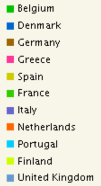
 Eurozone Debt to GDP %
After Greece comes Italy and then Portugal. Will the same thing that happened to Greece happen to those two last mentioned.  Will the Euro last as a common currency? I would say there is a lot of tension in the air right now and no reason to buy stocks that are following the general market cycle. Stockpicking can still be profitable but I think the time of easy profits and bull market rallies is over. 
This is no investment advice, it is just my opinion. Give it a thought.


Money never sleeps ... even on a saturday night


Lately I have been lazy and lacking inspiration to write about or research the markets.  I have been on a vacation and it is now time to pull myself together and start seriously back testing my new startegy. 

I am working on a strategy that takes into account both fundamental and technical factors. This strategy is a blend O´neills investment philosophy and trend following. Since I have no idea where the markets are heading it is smart to stay outside, observe and research. In Chinese the word "Crisis" means also opportunity, so if we are going to have a period of a bear market I will be then ready when the markets are turning and instruments are undervalued.

To trade like an institution


First of all let us define what an institutional investor is. Investopedia.com defines an institutional investor as follows: A non-bank person or organization that trades securities in large enough share quantities or dollar amounts that they qualify for preferential treatment and lower commissions. Instituional investors face fewer protective regulations because it is assumed that they are more knowledgeable and better able to protect themselves.

Hereby we can assume that investopedia is reffering to pension funds, mutual funds, hedge funds, insurance companies, investment banks etc. The institutional counterpart has a larger amount of equity to invest than an average commercial trader and the reasons why they trade a specific instrument can have various backgrounds: An institution might buy an instrument to close a short position or it might buy so that its mutual fund fills a specific fund criteria. Usually institutional trading can be noticed trough the order book, or watching the trade volume. As per se the institutions trade high volume contracts they might buy in blocks so that the market supply is enough and their market exposure is not too obvious. The funds originate mostly from the customers deposits. As the institution is obligated to maximize the customers returns it simply cannot spray it´s funds around the market. An institution trades relying on a definitive trading strategy. This strategy has been back tested and has been approved by the board. Thus we can define a few important steps to start trading like the big boys do:

1. Create a trading strategy that is easy to understand and has definitive conditions ( can be explicated in a mathematical equation, technical parameters or code) 


2. Back test the strategy (e.g. manually or by programming it). Try to be as realistic and objective as possible. 


3. If the strategy shows satisfying returns write the strategy down and hang it on the wall next to your trading station


4. Trade ONLY on the basis of the strategy! Rely on your strategy since it has proven to be somewhat profitable in the back testing phase. Every strategy shows negative returns at times. These periods may take several days to weeks, even months.


5. Put every trade in a table (e.g. an excel sheet) and derive statistics from them. Every trade has to be written down and rationalized with your strategy. In the future you can then look back at the failures and even try to avoid them in the future.